
After 40, the skincare aisle gets loud. Every jar promises to turn back the clock, and most of them are selling hope in expensive packaging. As a Physician Assistant and licensed esthetician, I read the research so you do not have to. Here are five of the ingredients with the strongest evidence behind them, and five popular ones I would not spend my money on.
Quick note: This is general skincare information, not medical advice. For prescription options or skin conditions, talk with your own clinician.
Why this list matters more after 40
In your 20s, you could get away with a cleanser and hope. After 40, your skin makes less collagen, renews itself more slowly, and holds less moisture, so every dollar you spend should go toward something with proof behind it. The beauty industry knows women in their 40s and 50s spend more on skincare than any other group, which is exactly why the hype gets louder the older you get. This list is my filter: what the research supports, and what it does not.
Worth your money
1. Sunscreen
I know, it is not exciting. It is also the single most proven anti-aging product you can buy. In a randomized trial of more than 900 adults in Australia, the group assigned to use sunscreen daily showed no detectable increase in skin aging over 4.5 years, and ended up with 24% less skin aging than the group that used it only when they felt like it (Hughes et al., Annals of Internal Medicine, 2013). No serum on earth has that kind of data. Broad spectrum, SPF 30 or higher, every single morning. This is the foundation everything else sits on.
2. Retinoids
The vitamin A family, including retinol and prescription tretinoin, has the deepest research file of any anti-aging topical. In double-blind trials, tretinoin improved fine wrinkles, roughness, and mottled pigmentation within months (Weiss et al., JAMA, 1988), and biopsy studies showed it actually increased new collagen formation in sun-damaged skin (Griffiths et al., New England Journal of Medicine, 1993). If you buy one active ingredient in your 40s, most dermatologists would tell you to make it this one. Start low, go slow, and wear your sunscreen.
3. Vitamin C
Used in the morning under sunscreen, vitamin C is one of the best-supported antioxidants in skincare. A major review found that vitamin C supports collagen synthesis and helps defend skin against UV-related damage (Pullar, Carr and Vissers, Nutrients, 2017). A later systematic review of clinical trials concluded that topical vitamin C can visibly improve signs of photoaging and uneven pigmentation (Correia and Magina, Journal of Cosmetic Dermatology, 2023). I consider it a strong supporting player rather than a non-negotiable: the evidence is real but thinner than for sunscreen or retinoids. Look for L-ascorbic acid in opaque, airtight packaging, since it breaks down with light and air exposure.
4. Niacinamide
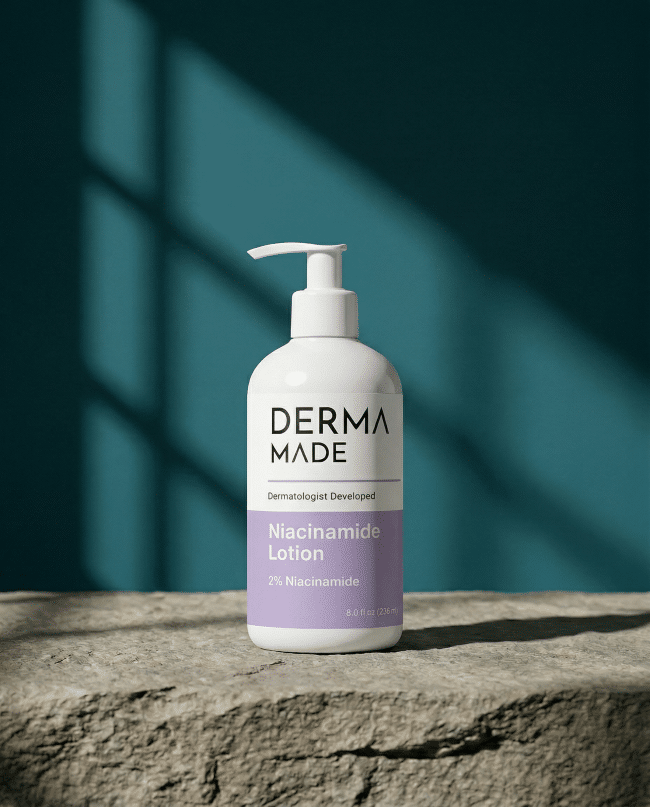
This form of vitamin B3 is the quiet multitasker I recommend constantly. In a 12-week, double-blind, split-face trial in 50 women, 5% niacinamide improved the appearance of fine lines and wrinkles, dark spots, red blotchiness, and skin elasticity compared to the control side (Bissett et al., Dermatologic Surgery, 2005). It is also one of the gentlest actives on this list, which makes it a great pick for sensitive skin or for layering alongside a retinoid.
5. Ceramides and a good moisturizer
After 40, your skin barrier gets thinner and drier, and no active ingredient works well on a compromised barrier. Ceramides are fats your skin naturally makes to hold moisture in and irritants out, and moisturizers that replenish them help your skin tolerate everything else on this list. This one is less about a single miracle study and more about consistent dermatology guidance: a healthy barrier comes first, actives second. If your skin stings, flakes, or feels tight, fix the barrier before you buy anything stronger.
Save your money (the hype list)
I am going to be careful here, because "no good evidence" is not the same as "proven useless." But when an ingredient costs a premium and the evidence is thin or missing, I think you deserve to know.
1. Topical collagen creams. Collagen is a large protein, and there is no good evidence that rubbing it on your face rebuilds collagen in your dermis. Your skin is designed to keep big molecules out. Ingredients that signal your skin to make its own collagen, like retinoids and vitamin C, have far better support.
2. Stem-cell creams. Most of these contain plant stem cells. There is no credible evidence that plant stem cells turn into human skin cells or meaningfully change aging skin. It sounds futuristic. The research is not there.
3. Gold-infused anything. Gold leaf in a cream looks luxurious on Instagram. I have not seen credible clinical evidence that it does anything for wrinkles, firmness, or tone. You are paying for the shimmer.
4. "Botox in a jar" creams. Some peptide creams claim to relax wrinkles like an in-office treatment. Peptides are an interesting area of research, but the evidence is thin compared to retinoids, and no cream has been shown to do what a neuromodulator does in a clinic. If a jar promises injection-like results, keep your wallet closed.
5. Permanent pore shrinkers. Pore size is mostly genetic and hormonal. Products can make pores look smaller temporarily by clearing out debris or mattifying oil, but no cream permanently shrinks your pores. Anyone selling you that is selling you the dream, not the data.
Putting it together: the simple order
If your head is spinning, here is the whole list in routine form. Morning: gentle cleanser, vitamin C serum, moisturizer with ceramides, then sunscreen. Night: cleanser, retinoid (start two to three nights a week), then moisturizer. Niacinamide can slot into either routine; it plays well with almost everything, which is part of why I love it.
Notice what is not in that routine: a ten-step lineup, a separate product for every concern, or anything with gold flakes. Five proven ingredients, applied in the right order, consistently. That is the entire strategy. Complexity is usually a sign that someone is trying to sell you more jars, not better skin.
One more practical tip: introduce one new active at a time and give it a week or two before adding the next. If something irritates your skin, you will know exactly which product did it. Your future self, calmly troubleshooting instead of guessing, will thank you.
The takeaway
After 40, your money goes furthest on the boring, proven stuff: sunscreen every morning, a retinoid at night, vitamin C and niacinamide in between, and a barrier-supporting moisturizer holding it all together. Everything else is optional.
If you want the full roadmap, my guide Your Skin After 40: A PA’s Guide to What Actually Works is available now. It goes deeper on all of this: routines by skin type, which in-office treatments are worth it, and exactly how to build a routine you will actually stick with.
And if you want to start with products I personally recommend, visit my shop and use code KEYLA50 for 50% off. Spend where the evidence is. Your skin, and your budget, will be better for it.


