
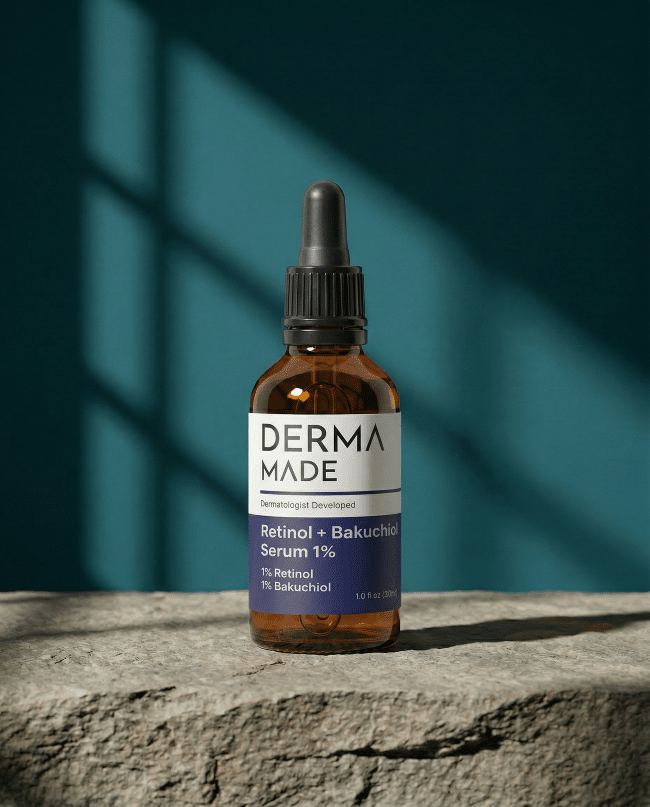
If you have ever stood in a skincare aisle (or fallen down a late-night internet rabbit hole) wondering about retinoid vs retinol, you are not alone. The words get tossed around like they are interchangeable, and they are not. As a Physician Assistant and licensed esthetician, this is one of the questions my clients ask me most. Here is the plain-English version.
Quick note: This is general skincare information, not medical advice. Talk with your own clinician before starting a prescription product.
First, the vocabulary problem
"Retinoid" is the umbrella term. It covers the whole family of vitamin A derivatives used on skin. "Retinol" is one specific member of that family, and it happens to be the one you can buy over the counter.
Think of it this way: retinoid is the last name, retinol is one kid in the family. Other family members include retinal (also called retinaldehyde), adapalene, tazarotene, and tretinoin. Some of these you can buy at the store. The strongest ones need a prescription.
Why does the family matter? Because your skin cannot use most of these ingredients as-is. Retinol has to convert inside your skin, first into retinal and then into retinoic acid, before it can do its real work. Each conversion step loses some strength along the way. Tretinoin, on the other hand, is already retinoic acid. It skips the line. That is a big reason prescription options tend to outperform drugstore ones, and also why they tend to irritate more.
What the research actually says
Here is where I get excited, because retinoids are one of the very few skincare ingredients with decades of real clinical research behind them.
The story started in the mid-1980s, when dermatologist Albert Kligman and colleagues first reported that topical tretinoin could improve the signs of photoaging, the wrinkles, roughness, and blotchiness caused by years of sun exposure (Kligman et al., Journal of the American Academy of Dermatology, 1986).
Then came the gold-standard trials. In a double-blind, vehicle-controlled study, Weiss and colleagues found that topical tretinoin improved surface roughness, mottled pigmentation, and fine wrinkles in photoaged skin within the first 4 to 10 months of use (Weiss et al., JAMA, 1988). Later, Griffiths and colleagues showed something even more interesting under the microscope: tretinoin actually increased collagen formation in sun-damaged skin (Griffiths et al., New England Journal of Medicine, 1993). That is not marketing language. That is new collagen, measured in biopsies.
To be fair, most of the strongest evidence is for tretinoin specifically, not for every over-the-counter retinol on the shelf. Retinol has supportive evidence too, but the prescription retinoids are the ones with the deepest research file. When dermatologists say retinoids are the most proven anti-aging topical we have, tretinoin is largely what they mean.
So which one should you buy in your 40s?
It depends on your skin, your patience, and your tolerance for a little peeling. Here is how I think about it with my clients.
Start with over-the-counter retinol if: you have never used a retinoid before, your skin is sensitive or reactive, or you want to ease in without a prescription. A low-strength retinol used consistently for months will do more for you than a prescription tube that sits in your drawer because it burned your face off in week one.
Consider asking a clinician about tretinoin if: you have been using retinol consistently for several months and your skin handles it well, your main concerns are established fine lines, uneven tone, or rough texture, and you want the option with the strongest evidence. Tretinoin comes in different strengths, and a clinician can help you pick a starting point that fits your skin.
Adapalene deserves a mention too. It started as an acne treatment, but it is now available over the counter and it is generally less irritating than tretinoin. Most of its research is in acne rather than photoaging, so it has less anti-aging data than tretinoin. For some of my clients in their 40s, it is a nice middle ground.
There is no prize for starting with the strongest thing. The best retinoid is the one you will actually use, consistently, for months.
What do retinol percentages actually mean?
Over-the-counter retinol usually comes in 0.25%, 0.5%, or 1.0%. These numbers describe concentration, not a guarantee of results, and higher is not automatically better for you. If you are new to retinoids or your skin is sensitive, starting at 0.25% or 0.5% is the smart move. You can always move up once your skin has adjusted. A lower strength you use every night beats a higher strength that irritates you into quitting.
One more label tip: "retinyl palmitate" and similar retinyl esters are even gentler and weaker than retinol, because they need an extra conversion step in the skin. They are fine for very sensitive beginners, but do not expect the same level of change. And packaging matters more than people think. Retinoids break down with light and air, so pump bottles and opaque tubes protect the formula better than open jars you dip your fingers into.
How to start without wrecking your skin
Almost everyone who quits a retinoid quits because of irritation, and almost all of that irritation is preventable. Here is the starter method I give my clients:
- Pea-sized amount, whole face. That is genuinely enough. More product does not mean faster results, it means more redness.
- Two to three nights a week at first. Build up to nightly over several weeks or months, only if your skin stays calm.
- Moisturizer is your best friend. Apply your retinoid to dry skin, then layer moisturizer on top. If you are very sensitive, try the "sandwich" method: moisturizer, then retinoid, then moisturizer again.
- Sunscreen every morning, no exceptions. Retinoids make your skin more sun-sensitive, and sun exposure undoes the very improvements you are working toward.
- Give it time. The real changes in the research showed up at 4 to 10 months. If you judge it at week three, you are judging the peeling phase, not the results phase.
A little dryness and flaking in the first few weeks is normal. Intense burning, swelling, or a rash that will not calm down is not. Back off or check in with a clinician if that happens.
Who should skip it or wait
Avoid retinoids if you are pregnant, trying to become pregnant, or breastfeeding, unless your own clinician specifically tells you otherwise. Prescription retinoids carry well-known pregnancy warnings, and caution is the right call with over-the-counter versions too.
If you have very sensitive skin, active eczema, or rosacea in a flare, get your skin calm first. A retinoid on inflamed skin is a bad first date. And if you are using other strong actives, like high-strength acids or benzoyl peroxide, do not layer everything at once. Simplify first, then add.
The bottom line on retinoid vs retinol
Retinoid is the family name. Retinol is the gentlest over-the-counter member. Tretinoin is the prescription heavyweight with the strongest evidence for aging skin. In your 40s, either path can work, but the prescription path should go through a clinician, and every path requires sunscreen and patience.
If you want help figuring out which starting point fits your skin, that is exactly what my Virtual Skin Consultation is for. It is $75, it is one-on-one, and you will leave with a plan built for your skin, not a generic routine.
And if you are starting with the gentle route, I keep a small collection of beginner-friendly options in my shop. Use code KEYLA50 for 50% off. Start low, go slow, and stay consistent. Your skin in six months will thank you.


